
German Shepherd Grooming: A Complete Guide for GSD Owners
If you live with a German Shepherd, you already know what the floor looks like on any given Tuesday. Fur on the couch. Fur on your pants. Fur in places fur has no business being.
Here is the thing though: grooming a GSD is not hard. What gets people is the consistency. Miss a week of brushing and you will feel it. Stay on top of it and the whole thing takes maybe 20 minutes a few times a week.
There is also more to it than managing the hair situation. Regular grooming means you are actually paying close attention to your dog on a regular basis. You notice things. A lump, a cut, a skin irritation that would have gone unnoticed for weeks otherwise.
Understanding the German Shepherd Double Coat
Before you pick up a brush, it helps to know what you are actually dealing with. German Shepherds have what is called a double coat. Two layers, completely different jobs.
The outer layer is the guard coat. Coarser hairs, weather-resistant, the ones you see. It sheds water, blocks UV, and takes the brunt of whatever your dog runs through outside.
Then there is the undercoat underneath. Dense, soft, almost woolly. This is the layer that regulates body temperature, warmth in winter, a cooling air buffer in summer. It is also the main source of all that fur you find everywhere.
Both layers need attention, but the undercoat is where most of the work is. A brush that only skims the surface is basically useless on a GSD. You need something that actually gets through to that bottom layer without tearing up the guard hairs on top.
One more thing worth knowing: according to the AKC breed standard, German Shepherds come in two coat types, standard and long. Same double-layer structure either way, but long coat GSDs mat faster and need more frequent brushing. We will get to that.
German Shepherd Shedding: What You Need to Know
German Shepherds shed year-round. That is just the reality. But twice a year, usually in spring and fall, they go through what is called a coat blow: a heavier shedding period where the undercoat sheds in large amounts over two to four weeks. During these periods, daily brushing is not optional if you want to keep things manageable.
For a full breakdown of the shedding cycle, why it happens, and what you can do to reduce it, we have a dedicated guide: German Shepherd Shedding: What to Expect and How to Manage It.
The short version: regular brushing is your best tool. It removes loose hair before it ends up on your floors, reduces matting, and keeps the coat healthy.
How to Groom a German Shepherd: Step by Step
Brushing
For a short-coat GSD, two or three sessions a week is fine under normal circumstances. Long-coat dogs need it daily. That is just the reality with this breed.
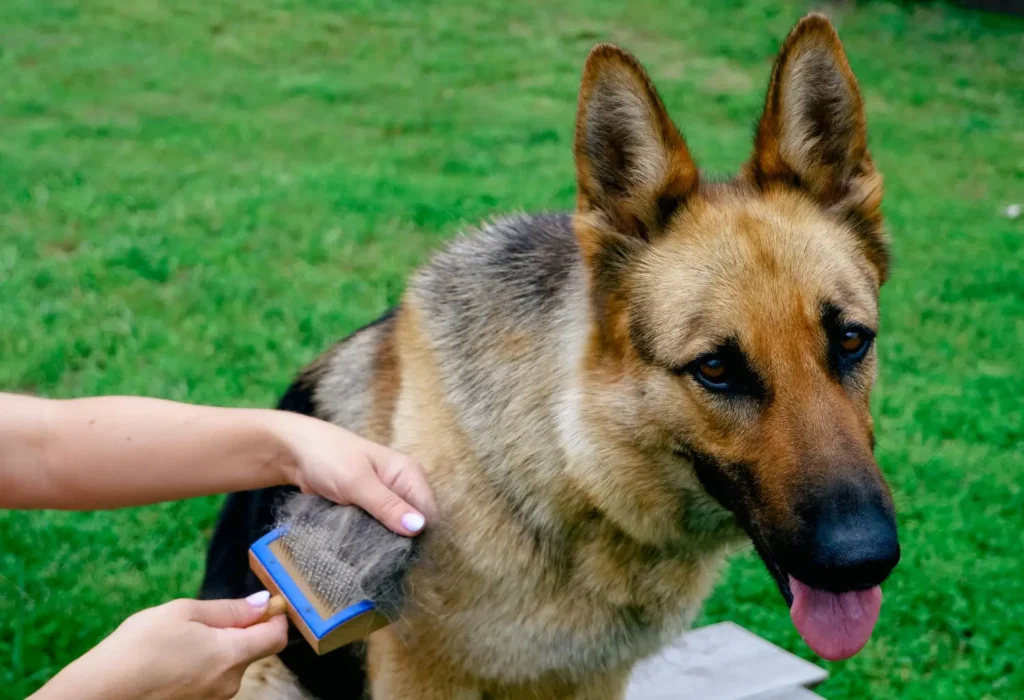
Start with an undercoat rake or slicker brush and work in sections. Go with the coat first, then against it to pull out what is sitting in the undercoat. The spots that mat fastest: behind the ears, under the collar, backs of the legs, and around the tail. Those areas need extra attention every single time.
Long-coat dogs: check for tangles before you start brushing. Running a brush through a knotted section hurts the dog and breaks the coat. Use a wide-tooth comb and detangling spray to work through knots first, then brush.
One thing people get wrong: attacking a dirty dry coat with a brush. If your dog came in covered in mud, let it dry, break up the chunks by hand, then brush. Forcing a brush through wet dirty fur will rip it.
Bathing
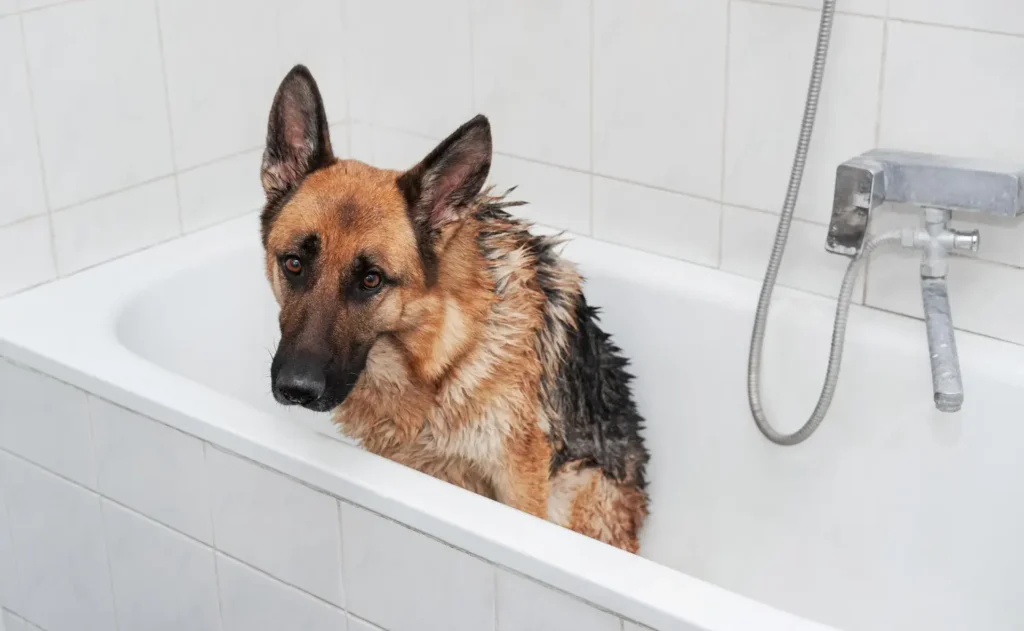
Most GSDs only need a bath every six to eight weeks. Bathing more often than that strips the coat of its natural oils and you end up with dry, flaky skin.
That said, common sense applies. If your dog rolled in something, smells, or is visibly dirty, wash them. Just use a dog-specific shampoo. Human shampoo is the wrong pH for dog skin and causes irritation with repeated use.
The part most people rush: rinsing. German Shepherds have a thick undercoat that holds shampoo longer than you would expect. Keep rinsing until the water is completely clear. According to VCA Animal Hospitals, leftover shampoo in the coat is one of the most common causes of skin problems in dogs groomed at home, more so than the product itself.
After the bath, towel dry and let them air dry somewhere warm. A high-velocity dryer speeds things up and blows out loose undercoat at the same time, which is useful during heavy shedding periods. Keep heat settings low.
Nail Trimming
Every three to four weeks, roughly. The easiest way to tell they are overdue: clicking on hard floors. At that point the nail is already long enough to affect posture and put pressure on the toe joints.
Use sharp clippers or a rotary grinder. Take small amounts at a time. You are watching for the quick, the pink blood vessel inside the nail. On black nails, look for a dark chalky circle appearing at the center as you trim. Stop there.
If you hit the quick it bleeds. Styptic powder stops it quickly. Keep some nearby the first few times.
Dogs that hate nail trimming: start by handling their paws regularly outside of grooming time, nothing high stakes, just normal contact. Build up to the clippers slowly and use treats throughout. It takes a few sessions but most dogs come around.
Ear Care
Once a week, check the ears. You are looking for redness, smell, too much wax, or a dog that keeps scratching at them. Any of those things, see a vet.
For routine cleaning, use a vet-approved ear cleaner on a cotton ball. Clean what you can see. Do not push anything further into the ear canal.
GSDs are less prone to ear infections than breeds with floppy ears because the upright shape allows more airflow. Still, dogs that swim a lot or live somewhere humid need checks more often.
Teeth Brushing
Most owners skip this one. It is also one of the most impactful things you can do for your dog’s long-term health. Dental disease is extremely common in dogs and mostly preventable.
The AKC recommends daily brushing, or at least three times a week. Dog toothbrush, dog toothpaste. Human toothpaste has fluoride and xylitol, both toxic to dogs.
If your dog has never had their teeth brushed, go slow. Let them lick the toothpaste off your finger first. Then rub their gums with your finger. Then introduce the brush. Takes a few weeks to become routine but most dogs tolerate it fine once they are used to it.
Best Tools for German Shepherd Grooming
You do not need a cabinet full of products. These are the tools that actually do the work:
- Undercoat rake: the single most important tool for a GSD. Gets through the dense undercoat and pulls out loose fur before it hits your floors. Use this first during regular brushing sessions.
- Slicker brush: fine wire pins that smooth the topcoat and catch finer loose hair after the undercoat rake. Good for a finishing pass.
- Deshedding tool (e.g. Furminator): useful during heavy shedding periods. Use sparingly and not too aggressively; overuse can thin the coat.
- Wide-tooth comb: essential for long-coat GSDs to work through tangles before brushing.
- Dog nail clippers or rotary grinder: either works. Clippers are faster; grinders are easier to control if you are nervous about the quick.
- Dog-specific shampoo: look for something formulated for double coats or for shedding reduction. Avoid anything with harsh sulfates.
- High-velocity dryer: not essential, but speeds up drying significantly and blows out loose undercoat. Worth it if you bathe at home regularly.
Skip the cheap combination tools that claim to do everything. They tend to do nothing particularly well.
How Often Should You Groom a German Shepherd?
Here is a quick reference guide:
Dog Grooming Schedule
| Task | Frequency | Notes |
|---|---|---|
| Brushing (short coat) | 2-3x per week | Daily during coat blows |
| Brushing (long coat) | Daily | Tangles behind ears, legs, tail |
| Bathing | Every 6-8 weeks | More often if visibly dirty |
| Nail trimming | Every 3-4 weeks | Click on floor = too long |
| Ear check | Weekly | Clean if dirty or smelly |
| Teeth brushing | Daily ideally, 3x/week min | Use dog-safe toothpaste only |
These are baselines. Individual dogs vary. A GSD that spends a lot of time outdoors, swims, or rolls in dirt will need more frequent baths. A dog that exercises on hard surfaces naturally wears down their nails and may need less frequent trimming.
Short Coat vs Long Coat: Grooming Differences
Both coat types have the same double-layer structure, but day-to-day maintenance is different.
Standard coat GSDs are lower maintenance. Two to three brushing sessions per week keeps things under control outside of shedding season, and a monthly bath is usually enough. Matting is rare.
Long coat GSDs need daily brushing. Tangles develop quickly, especially in the feathering behind the ears, along the back of the legs, and on the tail. Left unchecked, these turn into mats that are uncomfortable to remove. Long-coat dogs also take longer to dry after a bath and may benefit from a thorough blow-dry to prevent the undercoat from staying damp.
For a full look at the differences between GSD coat types, including how to identify them, visit our guide: German Shepherd Coat Lengths Explained.
Should You Shave a German Shepherd?
No. Do not shave your German Shepherd.
It is a common instinct, especially in summer, to think shaving will help the dog stay cool. The opposite is true. The double coat is a thermal regulation system. The undercoat creates an insulating air barrier that keeps heat out just as effectively as it keeps warmth in during winter. Shaving removes that protection.
On top of that, shaving can permanently damage the coat. The undercoat and topcoat grow back at different rates, which can cause a condition called coat funk or post-clipping alopecia, where the coat grows back patchy, coarse, or does not fully return to its original texture. Once this happens, there is no guaranteed fix.
If your GSD seems to be struggling in the heat, better options are: regular deshedding to remove loose undercoat, access to shade and fresh water, a cooling mat or paddling pool, and limiting outdoor activity to cooler parts of the day. A well-groomed double coat handles heat far better than a shaved one.
The exercise and activity needs of your GSD are closely tied to their overall health in summer. Our guide on how much exercise a German Shepherd needs covers how to adjust activity during hot weather.
A Note on Professional Grooming
Most of this you can handle at home. No special skills needed. But there are a few situations where a professional groomer is worth it: during coat blows when the volume of loose fur gets out of hand, if your dog absolutely refuses to let you near their nails, or when you notice something in the coat or skin that does not look right and want someone else to take a look.
If you go that route, find someone who actually works with double-coat breeds regularly and offers deshedding treatments specifically. A proper bath, brush, and blow-dry session from someone who knows what they are doing will pull out more undercoat than weeks of home brushing. It makes a real difference during heavy shedding season.
Grooming as Part of Overall GSD Health
There is something grooming does that has nothing to do with how the dog looks. When you are brushing and handling your dog consistently, you notice things. A new lump. A patch of irritated skin. A tick that has been there two days. A cut on the paw that would have gone unnoticed. Catching that stuff early matters.
It also connects to exercise. A GSD that is not getting enough activity shows it in their coat and their behavior. Duller fur, more anxious during grooming, stress-related skin issues. The two things feed into each other more than people realize.
For a closer look at what day-to-day life with a GSD actually looks like, including how males and females differ in coat and temperament, check our guide on male vs female German Shepherds.
Thinking about bringing a German Shepherd into your home? At Shepherd Kingdom, our puppies are raised with early handling and socialization that makes grooming routines far easier to establish from day one. View our available puppies or contact us with any questions.
Frequently Asked Questions
How often should I brush my German Shepherd?
Two to three times per week for short-coat GSDs, daily for long-coat GSDs. During shedding season (spring and fall), daily brushing is the standard for both coat types.
Do German Shepherds need professional grooming?
Not necessarily, but a professional groomer can be helpful during heavy shedding periods or if your dog is difficult about nails. Most regular maintenance can be done at home with the right tools.
How do I reduce German Shepherd shedding?
Regular brushing with an undercoat rake is the most effective method. Bathing followed by a blow-dry helps remove loose fur in bulk. Diet also plays a role: a high-quality diet with adequate omega-3 fatty acids supports coat health. See our full guide on German Shepherd shedding for more detail.
Can I use human shampoo on my German Shepherd?
No. Human shampoo has a different pH than dog skin requires and can cause dryness and irritation with regular use. Use a shampoo formulated for dogs, ideally one suited to double-coat breeds.
Why does my German Shepherd scratch after bathing?
Usually this means shampoo residue was left in the undercoat. Rinse longer than you think you need to. If scratching persists, your dog may have a skin sensitivity to the shampoo you are using.
When should I start grooming my German Shepherd puppy?
As early as possible. Puppies that are introduced to brushing, nail trimming, and ear handling from a young age accept grooming as a normal part of life. Keep early sessions short, positive, and treat-heavy. The habits you build in the first few months pay off for years.
Is it OK to shave a German Shepherd in summer?
No. Shaving removes the double coat’s natural insulation, which actually helps regulate body temperature in heat. It can also permanently damage the coat texture. Regular deshedding and access to shade and water are better ways to keep your GSD comfortable in warm weather.
