
How Fast Can a German Shepherd Run?
Watch a German Shepherd at full speed and it becomes obvious pretty quickly why this breed ends up in police K9 units, military roles, and search and rescue teams. They move differently from most dogs. There is something purposeful about it.
The short answer: a German Shepherd can run around 30 mph (48 km/h) at top speed. But that number on its own does not tell you much. How long can they hold that pace? How does it compare to other breeds? Can one actually catch a person trying to run?
This is all of that, explained properly.
How Fast Can a German Shepherd Run?
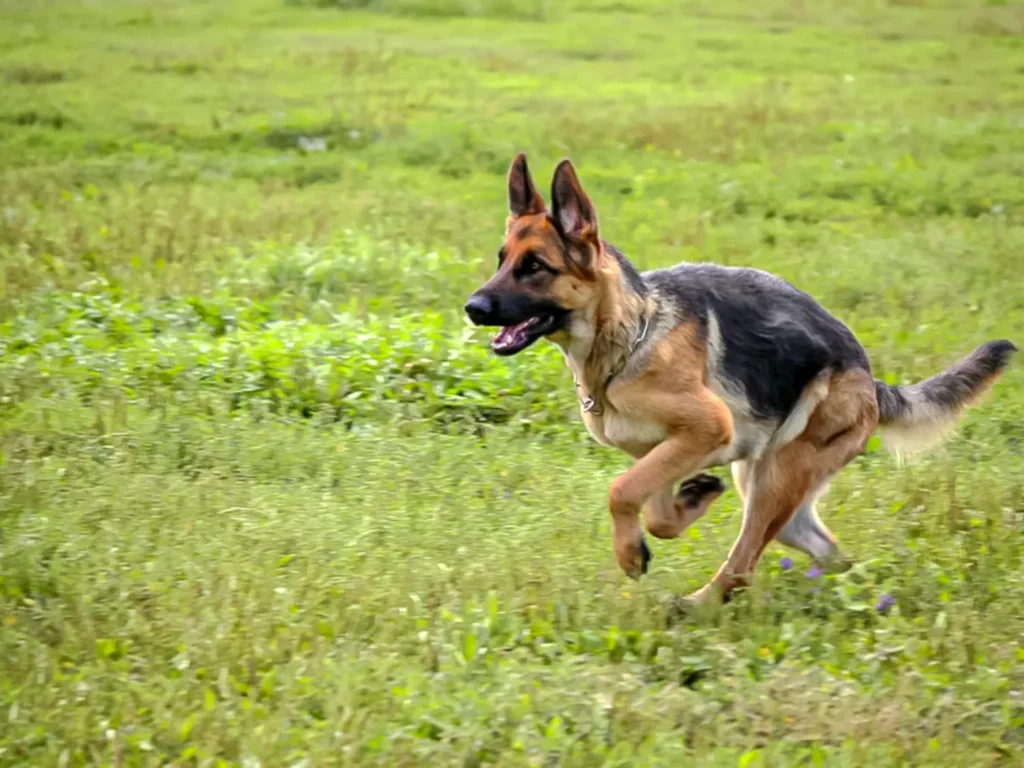
30 mph. That is 48 kilometers per hour. Not the fastest dog breed, but fast enough that a human running at full effort is not going to make it very far.
To put it in perspective: most people jog at 6 mph. A reasonably fit runner pushing hard might hit 9 or 10. Usain Bolt, the fastest human ever recorded, peaked at 27.8 mph during his world record 100 meter run. A German Shepherd at full sprint matches that. And unlike Bolt, the dog is not done after 100 meters.
The 30 mph figure is a peak sprint number, meaning a healthy adult GSD at full effort on flat ground. Not every dog hits exactly 30. Some are a bit faster, some slower. But it gives you the right ballpark.
German Shepherd Top Speed vs Average Running Speed
There is a difference between what a GSD can do in a short burst and what they actually run at day to day.
At full sprint, 30 mph. That is maximum effort, short duration. Think of it like a human doing a 100 meter dash.
At a comfortable trot, most adult German Shepherds move at around 15-20 mph. This is the pace they can sustain for longer stretches without pushing hard. If you are running with your dog and they look relaxed while you are breathing hard, this is probably where they are.
At a loose, casual pace alongside a human on a walk or easy jog, 5-8 mph. This is not running for them, it is just keeping up.
The thing that makes GSDs particularly impressive is not the top speed alone. It is the combination of speed and endurance. A Greyhound is faster but gasses out quickly. A German Shepherd can run hard for a sustained period, which is why they are effective in working roles that require actual pursuit, not just a short burst.
How Long Can a German Shepherd Run at Top Speed?
No dog holds top speed for long. That is just physics. Full sprint is maximum output and it burns fast, regardless of breed.
A fit GSD can hold something close to 30 mph for roughly 10 to 20 seconds before dropping back naturally. After that burst they settle into a strong trot, around 15 to 20 mph, which they can sustain for considerably longer.
That second gear is what makes the breed interesting. Most fast dogs fade quickly after the initial burst. A Greyhound will beat a GSD in a 200 meter race every time. Over two miles across varied terrain it is a different story entirely. A conditioned German Shepherd can run hard for 20 to 30 minutes without significant fatigue. Some go longer.
All of this assumes the dog is actually in shape. A GSD that barely exercises day to day is not operating at those numbers. If the routine needs work, Shepherd Kingdom has a full breakdown of what exercise actually looks like for this breed, including how much is enough and how much is too much.
How Does German Shepherd Speed Compare to Other Breeds?
Dog Breed Speeds
| Breed | Top Speed (mph) | Top Speed (km/h) | Notes |
|---|---|---|---|
| Greyhound | 45 | 72 | Fastest dog breed |
| Belgian Malinois | 35 | 56 | Closest to GSD in working roles |
| German Shepherd | 30 | 48 | Speed + endurance combination |
| Siberian Husky | 28 | 45 | Built more for sustained pace |
| Labrador Retriever | 12 | 19 | Not built for speed |
| Average human (running) | 8-10 | 13-16 | Elite sprinters reach 28 mph |
The Belgian Malinois is the closest working dog comparison. Slightly faster at around 35 mph, similar endurance, and increasingly preferred in some military and police roles where raw speed is the priority. The gap between a Malinois and a GSD is real but not enormous.
The Lab comparison is worth including just because people think of them as athletic. They are, but not in this way. A German Shepherd is roughly three times faster.
As for the build that makes all of this possible: the deep chest, strong hindquarters, and flexible spine are what the AKC breed standard points to as defining characteristics of the breed. The GSD was not designed for pure speed like a Greyhound. It was designed for efficiency of movement over sustained effort, which is a different and arguably more useful thing.
Can a German Shepherd Outrun a Human?
Yes. Easily.
A German Shepherd runs at three to four times the speed of a typical person. Even a very fit human running hard cannot outrun a GSD over any meaningful distance. The gap closes a little on rough terrain, tight turns, or obstacles, where human coordination and body mechanics can compensate somewhat, but in open space there is no contest.
This is one of the reasons German Shepherds are used in police K9 work. A suspect who decides to run is not going to outrun the dog. The GSD does not need to be right behind them at the start. It will close the gap.
The only realistic way a human outruns a German Shepherd is if the dog is old, injured, severely out of condition, or simply not motivated to chase. In all other circumstances, the dog wins.
What Affects a German Shepherd’s Running Speed?
Age
Puppies are fast but not at adult capacity. GSDs reach physical maturity around 18-24 months, and their running ability peaks in early to mid adulthood. After about seven years old, speed and endurance both start to decline gradually. Senior dogs can still move well, but they are not operating at the same level as a three-year-old dog.
Joint health plays a big role in older dogs. Hip dysplasia is one of the most common conditions in the breed and directly affects how a dog moves and how fast it can run comfortably. A dog with significant joint issues will not hit anywhere near peak speed.
Weight and body condition
An overweight GSD moves slower and tires faster. Excess weight puts stress on joints and reduces efficiency of movement. A dog at a healthy weight for their frame runs faster and recovers better after exercise.
The weight chart shows what healthy weight ranges look like for German Shepherds at different ages. A dog significantly above that range is carrying extra load that affects everything, speed, endurance, and long-term joint health.
Working line vs show line
Not all German Shepherds are built the same. Working line dogs (DDR, Czech, West German working line) tend to be leaner and more athletic. Show line dogs, particularly American show lines, are sometimes heavier and less agile. The differences between the various types of German Shepherds are meaningful when it comes to athletic performance.
A West German working line GSD is built for exactly this kind of sustained physical output. A show line dog may be closer to the lower end of the speed range.
Fitness level
A dog that runs regularly is faster and more efficient than one that does not. Muscle conditioning, cardiovascular fitness, and joint flexibility all improve with consistent exercise. A GSD that gets real daily activity is a different athlete from one that mostly sits around the house.
Terrain and conditions
Top speed is measured on flat, open ground. Grass, sand, gravel, inclines, wet surfaces — all of these affect how fast the dog can move. GSDs are agile enough to handle varied terrain well, but physics still applies. Loose sand or a steep hill will slow any dog down.
Are German Shepherds Good Running Partners?
For people who run regularly, a German Shepherd is one of the better breeds you could choose as a running companion.
They have the endurance to go long distances, the speed to match any human pace comfortably, and the temperament to stay focused during a run rather than getting distracted by every squirrel or other dog. They also benefit from the exercise in a real way, a tired GSD is a calmer, better-behaved dog at home.
A few things to know before running regularly with your GSD:
- Wait until the dog is at least 18 months old before doing serious distance running. Growing joints need time to develop fully before being stressed with repetitive impact. This is especially important given the breed’s
- Build distance gradually. Start with shorter runs and increase over weeks, not days.
- Watch for heat. German Shepherds have a dense double coat and overheat faster than humans do. Early morning or evening runs in summer, always with water available.
- Pay attention to paw condition. Hot pavement damages paw pads. If the ground is too hot for your bare hand for more than a few seconds, it is too hot for the dog’s paws.
- Let the dog set the pace occasionally. A dog that is pushing hard to keep up with you is not doing itself any favors.
How to Build Your GSD’s Running Endurance Safely
If you want a dog that can run hard with you, you have to build up to it. A GSD that has been mostly sedentary cannot immediately handle a five-mile run without consequences.
Start with brisk walks and short jogs mixed in. Add distance by no more than 10% per week. Monitor the dog’s recovery: if they are stiff the next day, limping, or reluctant to move after exercise, you pushed too hard.
Consistent shorter runs are better for building fitness than occasional long ones. A dog that runs 30 minutes four times a week builds condition faster and more safely than one that runs two hours once a week.
Diet matters too. A dog doing serious exercise needs enough protein and calories to support recovery. An active GSD burning significant energy on daily runs has different nutritional needs than a sedentary one.
As dogs age, adjust expectations. A seven-year-old GSD can still run, but the distances and intensity that were fine at three may be too much now. Lifespan and aging affect what is appropriate to ask of a dog physically, and senior dogs deserve a routine that accounts for that.
One often-overlooked part of keeping a running dog in good shape: coat and skin health. A dog that is regularly active outdoors accumulates debris, and a well-maintained coat stays healthier under repeated use. Worth keeping grooming consistent alongside an active exercise routine.
Speed as Part of What Makes This Breed What It Is
The German Shepherd’s speed is not a party trick. It is one part of what makes them genuinely capable working dogs. The combination of intelligence, trainability, endurance, and physical speed is what puts them in K9 units, on search and rescue teams, and at the top of protection dog rankings.
The bite force data tells a similar story. Every physical attribute of this breed points toward a dog that was built for serious work, not just companionship. Which makes them extraordinary companions when their needs are actually met.
Looking for a German Shepherd?
At Shepherd Kingdom our puppies are raised with activity and handling built into their routine from day one.
-
 Select options
Blossom
$1495Meet BlossomFemale 16 WeeksOne or both of this puppy's parents have undergone genetic testing.This puppy has had early neurological stimulation exercises. -
Select options
Beverly
$1495Meet BeverlyFemale 16 WeeksOne or both of this puppy's parents have undergone genetic testing.This puppy has had early neurological stimulation exercises. -
Select options
Harlow
$1795Meet HarlowFemale 13 WeeksOne or both of this puppy's parents have undergone genetic testing.This puppy has had early neurological stimulation exercises. -
Select options
Iris
$1795Meet IrisFemale 12 WeeksOne or both of this puppy's parents have undergone genetic testing.This puppy has had early neurological stimulation exercises.
Frequently Asked Questions
How fast is a German Shepherd in km/h?
Approximately 48 km/h at top speed. At a comfortable sustained trot, most German Shepherds move at around 25-32 km/h.
How long can a German Shepherd run at full speed?
Full sprint lasts around 10-20 seconds before the dog naturally drops to a sustainable pace. After the initial burst, a fit GSD can maintain a strong running pace for 20-30 minutes or more depending on conditioning.
Can a German Shepherd outrun a human?
Yes, easily. A German Shepherd runs at three to four times the speed of a typical person. Even elite human sprinters max out around 27-28 mph, which a GSD can match or exceed. Over any meaningful distance in open terrain, a GSD will catch a running person.
Are German Shepherds faster than Belgian Malinois?
No. Belgian Malinois are slightly faster, reaching around 35 mph compared to a GSD’s 30 mph. Malinois are also a bit lighter, which contributes to the speed advantage. Both breeds have comparable endurance for sustained running.
At what age can I start running with my German Shepherd?
Wait until at least 18 months old before doing serious distance running. Before that, the growth plates in a GSD’s joints are still developing, and repetitive impact from running can cause lasting damage. Short jogs on soft surfaces before that age are fine, but structured running should wait.
Does hip dysplasia affect a German Shepherd’s speed?
Yes, significantly. Hip dysplasia affects the hip joint’s structure and causes pain during movement. A dog with moderate to severe dysplasia will not run at anything close to normal speed and should not be pushed to do so. Regular veterinary monitoring and appropriate exercise management are important for affected dogs.
